

GROUND SQUIRREL: CALIFORNIA GROUND SQUIRREL GUIDE
Ground squirrels are highly destructive burrowing rodents that create extensive underground colonies throughout California. These social animals establish family groups that rapidly expand without professional intervention, causing significant property damage.
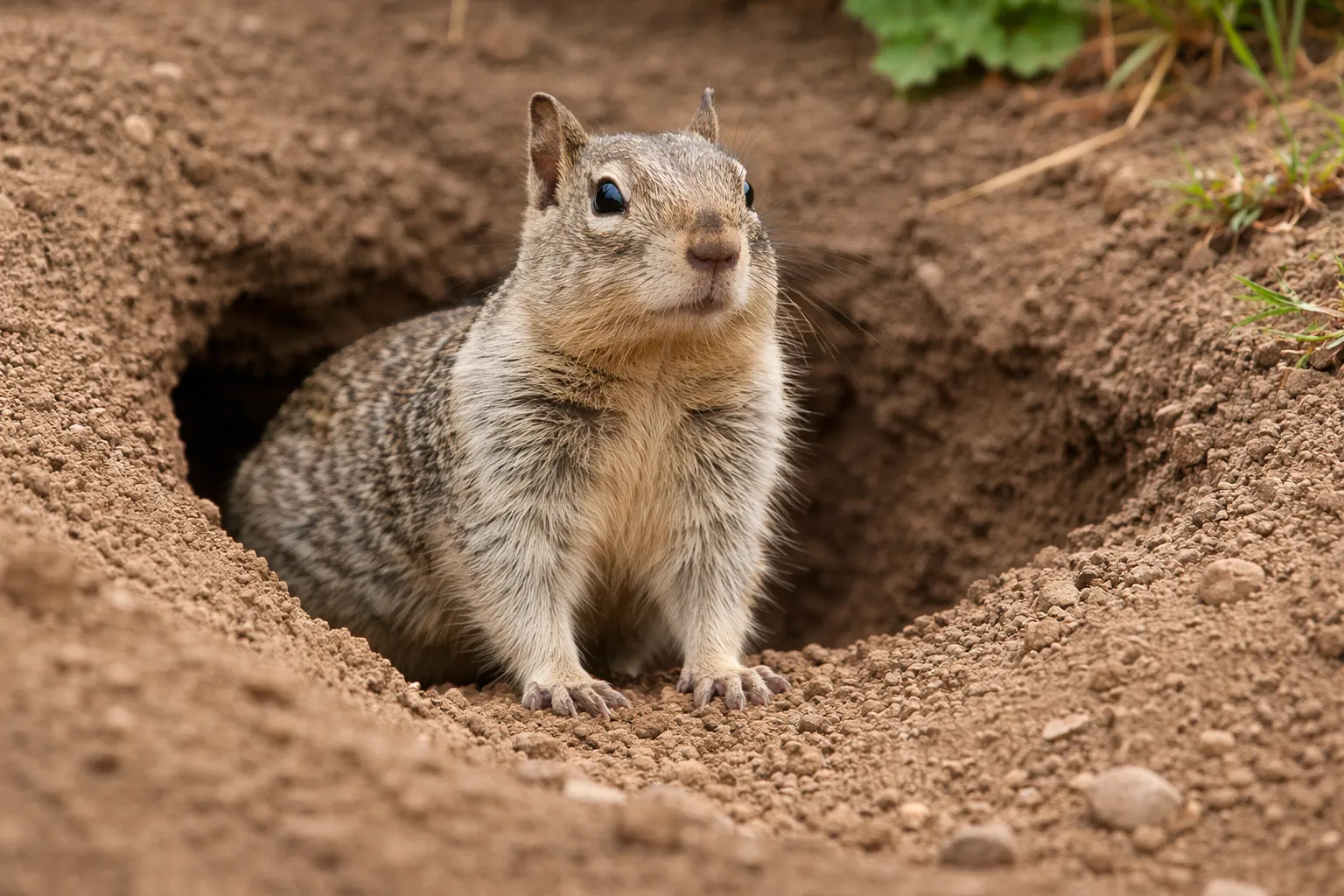
## California Ground Squirrel Identification
**Scientific Name:** Otospermophilus beecheyi (California ground squirrel)
**Size:** 9-11 inches long plus 5-9 inch tail, weighing 12-24 ounces
**Appearance:** Mottled brown and gray fur with lighter belly, bushy tail
**Features:** Prominent ears, strong claws for digging, alert posture when above ground
**Behavior:** Diurnal (active during daylight) with complex social structure
## Ground Squirrel vs Other Squirrels
**vs. Tree Squirrels:** Ground squirrels live in underground burrows; tree squirrels live in trees and elevated structures
**vs. Gophers:** Ground squirrels are frequently visible above ground; gophers remain underground
**vs. Chipmunks:** Ground squirrels are larger and lack distinctive facial stripes
## Ground Squirrel Burrow Systems
**Colony Structure:** Family groups establish interconnected burrow networks with multiple entrance holes and escape routes.
**Burrow Characteristics:**
**Territory Size:** Colonies can span several hundred square feet with 5-30 individuals per established group.
## Ground Squirrel Damage Patterns
**Structural Undermining:** Extensive burrow systems weaken foundations, patios, walkways, and retaining walls through soil displacement.
**Landscape Destruction:** Root damage from tunnel construction kills plants and disrupts irrigation systems.
**Safety Hazards:** Multiple hole openings create trip hazards for people and pets across property areas.
**Agricultural Impact:** Crop damage through root consumption and seed/nut gathering activities.
## Ground Squirrel Diet and Behavior
**Omnivorous Diet:** Seeds, nuts, fruits, vegetables, insects, and small animals
**Food Storage:** Cache food in underground chambers for winter consumption
**Social Structure:** Live in family colonies with complex communication and territorial behaviors
**Activity Patterns:** Most active during morning and late afternoon hours
## Ground Squirrel Reproduction
**Breeding Season:** Early spring (February-April) in California
**Gestation:** 25-30 days
**Litter Size:** 5-8 offspring per litter
**Annual Litters:** One litter per year
**Colony Expansion:** Rapid population growth as young establish nearby territories
## Ground Squirrel Seasonal Activity
**Spring:** Emergence from hibernation and breeding activity
**Summer:** Peak foraging and territorial establishment
**Fall:** Intensive food gathering and storage preparation
**Winter:** Reduced activity but remain active during warm periods in Southern California
## Professional Ground Squirrel Control
Effective ground squirrel control requires understanding of colony dynamics and behavior patterns:
**Population Assessment:** Complete evaluation of colony size, burrow extent, and territorial boundaries.
**Strategic Elimination:** Comprehensive trapping programs targeting entire family groups rather than individual animals.
**Exclusion Installation:** Physical barriers prevent ground squirrel access to high-value landscape and structure areas.
**Habitat Modification:** Property changes reduce ground squirrel attraction and make areas unsuitable for colony establishment.
## Why Professional Control is Essential
**Rapid Reproduction:** Ground squirrel colonies expand quickly without intervention, making early professional control critical.
**Complex Social Structure:** DIY methods often eliminate only visible individuals while missing colony members in burrow systems.
**Property Damage:** Extensive undermining requires professional assessment to prevent structural and safety issues.
**Humane Considerations:** California regulations require humane treatment during ground squirrel control operations.
## Regional Ground Squirrel Information
**California Distribution:** Throughout the state in suitable habitat including foothill, valley, and coastal areas.
**Urban Adaptation:** Highly successful in residential and commercial developments providing food and shelter resources.
**Climate Tolerance:** Adapted to Mediterranean climate with ability to survive seasonal temperature and moisture variations.
Ground squirrels represent one of the most challenging burrowing pest problems in California due to their social nature, rapid reproduction, and extensive burrow systems. Professional control ensures effective colony elimination while protecting property values and safety.
Call 909-599-4711 for professional ground squirrel assessment and control throughout California. Ground Squirrel Control Service | How to Get Rid of Ground Squirrels | Gopher vs Mole | All Services | All GuidesRelated Resources
Gopher Animal · Gopher Rat · Gopher Types · Gopher Vs Ground Squirrel · Gopher Vs Groundhog · Gopher Vs Prairie Dog · Ground Squirrel Holes · Ground Squirrel Trapping