

MOLE OR GOPHER MOUND: IDENTIFICATION GUIDE
Distinguishing between mole and gopher mounds is essential for choosing appropriate control methods. While both create soil disturbance, mole hills and gopher mounds have distinct characteristics that indicate different pest species requiring different treatments.

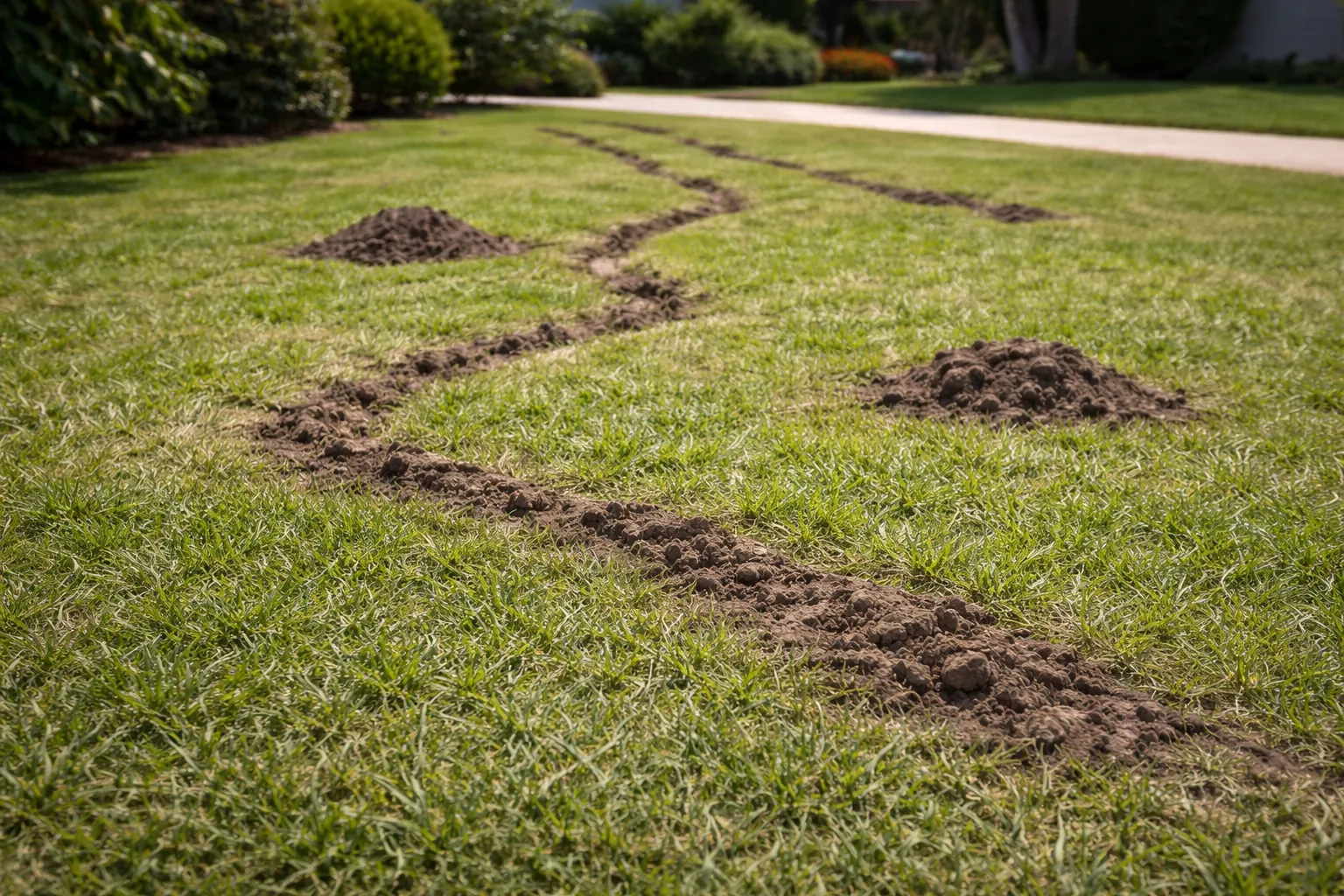
## Key Differences: Mole vs Gopher Mounds
| Feature | Gopher Mounds | Mole Hills |
|---------|---------------|-------------|
| Shape | Volcano or fan-shaped | Symmetrical cone |
| Hole Location | Off to one side | Centered underneath |
| Hole Condition | Plugged with soil | No visible hole |
| Soil Texture | Fine, uniform soil | Coarser soil and debris |
| Mound Size | 6 inches to 2 feet wide | 3-6 inches wide |
| Pattern | Random placement | Often in lines |
| Frequency | Daily new mounds | Several per day |
## Gopher Mound Characteristics
**Shape:** Volcano or fan-shaped with soil spread in one direction from the hole location.
**Hole Position:** Small plugged hole appears off to one side of the mound base, never in the center.
**Soil Quality:** Fine, uniform soil texture that appears freshly excavated without surface debris mixed in.
**Size Range:** Varies from 6 inches to 2 feet in diameter depending on soil conditions and gopher activity level.
**Formation Process:** Created when gophers push excavated soil to the surface through temporary openings that are immediately sealed.
## Mole Hill Characteristics
**Shape:** Symmetrical cone or dome shape with soil pushed up uniformly in all directions.
**Hole Position:** No visible hole on surface; soil is pushed up through the tunnel directly below the center of the mound.
**Soil Quality:** Often contains surface debris, grass, and varied soil textures from different tunnel depths.
**Size Range:** Typically smaller than gopher mounds, usually 3-6 inches in diameter.
**Formation Process:** Created when moles push soil straight up through their tunnels to the surface.
## Tunnel Systems: Mole vs Gopher
**Gopher Tunnel Signs:**
**Mole Tunnel Signs:**
## Seasonal Patterns: Mole vs Gopher Mounds
**Gopher Mound Activity:**
**Mole Hill Activity:**
## Location Patterns: Mole vs Gopher
**Gopher Mound Locations:**
**Mole Hill Locations:**
## Why Accurate Identification Matters
**Control Method Selection:** Moles and gophers require completely different control approaches and equipment.
**Treatment Effectiveness:** Wrong identification leads to ineffective control efforts and wasted time and money.
**Professional Services:** Species-specific expertise ensures appropriate assessment and treatment methods.
**Property Protection:** Understanding which pest is active helps predict damage patterns and prevention strategies.
## Professional Assessment: Mole or Gopher
**Mound Analysis:** Professional technicians can identify species from mound characteristics, soil texture, and formation patterns.
**Tunnel Mapping:** Specialized probing determines tunnel depth and structure indicating mole or gopher activity.
**Damage Evaluation:** Plant damage patterns help confirm species identification and assess population levels.
**Treatment Planning:** Accurate identification ensures appropriate control methods for maximum effectiveness.
## Common Identification Mistakes
**Mistake 1:** Assuming all soil mounds indicate the same pest species requiring identical treatment approaches.
**Mistake 2:** Using gopher control methods for mole problems (or vice versa) leading to treatment failure.
**Mistake 3:** Treating surface ridges as gopher tunnels when they actually indicate mole activity.
**Mistake 4:** Ignoring mound characteristics and relying only on tunnel visibility for species identification.
## Multiple Species Scenarios
**Both Moles and Gophers:** Some properties have both species requiring combined control approaches targeting different tunnel systems.
**Identification Challenges:** Mixed activity creates complex mound and tunnel patterns requiring professional assessment.
**Treatment Coordination:** Effective control addresses both species simultaneously using species-appropriate methods.
## DIY Identification Tips
**Document Patterns:** Photograph mounds and tunnels over several days to identify formation patterns and characteristics.
**Measure Mounds:** Record size, shape, and hole location for comparison with identification guides.
**Track New Activity:** Monitor where new mounds appear to understand territory patterns and activity levels.
**Note Timing:** Record when mounds appear relative to weather, irrigation, and seasonal changes.
## When Professional Help is Needed
**Complex Damage Patterns:** Multiple mound types and tunnel systems may indicate multiple pest species.
**Treatment Failures:** DIY control attempts that don't reduce mound formation suggest misidentification.
**Property Assessment:** Large-scale damage requires comprehensive evaluation to determine all active species.
**Guarantee Needs:** Professional species identification ensures appropriate control methods with guaranteed results.
Accurate mole or gopher mound identification is the foundation of effective pest control. Understanding these differences helps property owners choose appropriate professional services for permanent pest elimination.
Call 909-599-4711 for professional mole and gopher identification throughout Southern California. | All GuidesRelated Resources
Carbon Monoxide Mole Control · Do Moles Hibernate · Free Mole Inspection · Gopher Animal · Gopher Rat · Gopher Types · Gopher Vs Ground Squirrel · Gopher Vs Groundhog